ORCUTT PIONEER

Therapy Dogs Help Relieve Stress
for First Responders
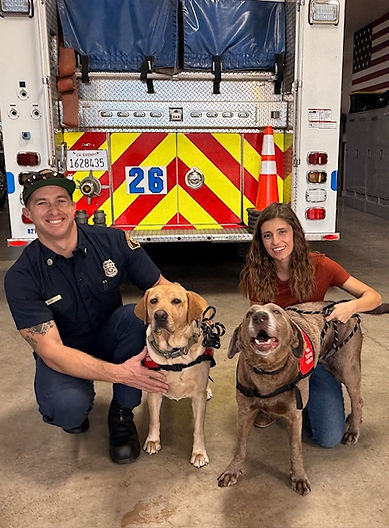
Seeing a dog, even if it is just sleeping in the corner, relaxes us. It’s a taste of home,” says Fire Captain Sam Dudley during a First Responder Therapy Dogs visit at Orcutt Fire Station #26, off Clark Road and Stillwell.
Orcutt resident Lacey Hayes and her two Labrador Retrievers, Ash and Indie, visit fire and sheriff stations on a regular schedule to increase well-being at these especially stressful jobs. Hayes says, “Even touching a dog’s ears has been proven to raise the level of oxytocin, a hormone that promotes peace. Hayes is part of a national group called First Responder Therapy Dogs, where both dogs and handlers are trained and certified to visit active fire-base camps, and fire and police stations to relieve stress.
Hayes’ father was in the police force, and the station was like a second home, a place where she did her homework. “I feel called to be involved with it,” says Hayes, who knows firsthand first responders’ level of stress. Hayes has studied social and behavioral sciences at Hancock College and plans to go into the mental health field when her children are older. Upon seeing how her lab, Ash, was a natural caretaker, knowing when to play and when to snuggle with people, she found and became certified with the First Responder group. Her area covers Orcutt’s two fire stations and sheriff’s department and extends to Grover Beach, Pismo and San Luis Obispo.
Both Orcutt fire stations house four alternating firefighters on 24-hour shifts. They often go without sleep, explaining that stress is part of the job. Besides fires, they go to emergencies never knowing what they will find—crashes with serious injury or death, someone who have fallen and broken a bone or have had a heart attack, a flood or other natural disaster. Besides being away from their families, missing holidays, and having irregular hours, first responders may be on call for prolonged natural disasters like the Madre and Gifford fires in the summer of 2025.
Dudley explains that a better understanding of mental health challenges has occurred in the last 20 years, and it is now a part of first responders’ training. Employees of both fire and police stations have wider access to mental health counselors. Years ago, alcohol was a common after work therapy, says Engineer Don Wilson, who has been with the force for 30 years.
“Suicide is the number one killer of firefighters, and police, more likely than a fire. We face so many hardships,” says Dudley.
Orcutt’s firefighters enjoy interacting with Lacey’s dogs. “The dogs make it feel a little more like home,” says Firefighter Rocky Lanning. Kyle Scheer describes how there was always a long line to pet the dogs at the Madre fire-base camp. Dudley adds how, after struggling with a tough call, sometimes you connect with the dogs and realize, “Oh, it’s actually time for a therapy session,” a service that has become more available for police and firefighters in recent times. Dudley also brings a Boxer named Rhonda to Station 26, who was trained by prisoners in jail. He says if he sees a firefighter that is particularly stressed after an incident he will say, “Go pet the dog. It’s an order.”
If you have a dog who is a good caretaker and you and your dog would like to join Hayes as a volunteer, contact firstrespondertherapydogs.com. Follow Lacey Hayes on Instagram at @diaryofashthelab.
Katy Jacobson reporting